Welcome to the OxyRevo Australia mHBOT Training Program. This course is designed for people who use an OxyRevo chamber at home, support clients in a health or wellness setting, manage a commercial chamber service, or need a reliable introduction to mild hyperbaric chamber technology.
This is an educational and operational training program. It is not a medical qualification, professional accreditation or authorisation to diagnose, treat or manage a health condition. It does not replace the instructions supplied with your chamber, individual healthcare advice, emergency training or any legal obligation that applies to your role.
Learning objectives
By the end of this module, you should be able to:
- Describe the purpose and scope of this training program.
- Explain how the Foundation Layer and learning tracks are organised.
- Recognise the limits of the course and your continuing responsibilities.
- Distinguish education from individual medical advice.
- Locate the instructions applying to your exact chamber model.
- Explain why accurate, evidence-informed communication matters.
1. What this course is
The OxyRevo Australia mHBOT Training Program is an education and operational-support resource for people who use, recommend or operate an OxyRevo chamber.
The course covers foundational terminology, the physics of increased atmospheric pressure, oxygen delivery, evidence literacy, risks and precautions, routine operation, emergency response, cleaning, maintenance, troubleshooting and the Australian regulatory and advertising environment.
Better-informed users make safer decisions, follow procedures more consistently and communicate about mHBOT more responsibly.
Throughout the program, the course distinguishes between established scientific principles, clinical hyperbaric medicine, emerging research, manufacturer specifications, operational recommendations and promotional claims. Biological plausibility, personal experience and early research do not automatically prove that an intervention safely or effectively treats a particular condition.
This course provides
- Foundational scientific knowledge
- Operational and safety education
- Model-specific learning prompts
- Evidence and compliance awareness
- Role-appropriate learning pathways
This course does not provide
- A medical or nursing qualification
- Professional registration or accreditation
- Authority to diagnose or treat
- Individual medical clearance
- A replacement for the chamber manual
Completion does not expand a registered practitioner’s scope of practice, guarantee that mHBOT is suitable for a particular person, replace workplace emergency preparation, or establish that a chamber or service is included in the Australian Register of Therapeutic Goods.
A person who has a health condition, takes medication, is pregnant, has recently undergone surgery or is unsure whether pressurised exposure is appropriate should obtain advice from an appropriately qualified healthcare professional before use.
2. How the course is structured
All participants begin with one shared Foundation Layer. After completing Modules F1–F7, participants continue into the track that most closely matches their role.
Essential knowledge completed by everyone
A1–A5
B1–B4
C1–C6
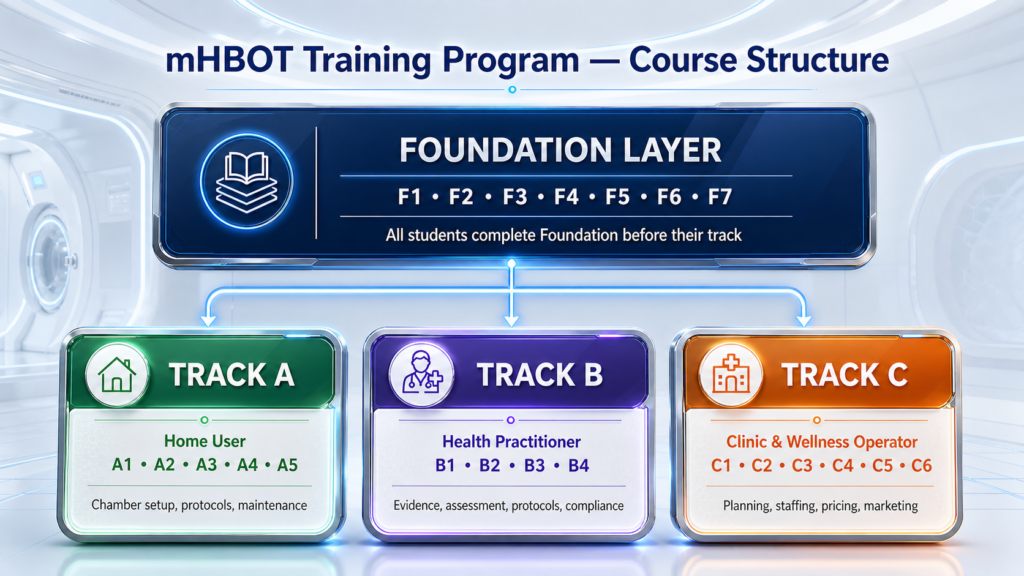
| Course section | Modules | Primary audience | Main focus |
|---|---|---|---|
| Foundation Layer | F1–F7 | All participants | Terminology, science, evidence, safety, Australian regulation, OxyRevo technology and emergency procedures |
| Track A: Home User | A1–A5 | Individuals and families | Model-specific setup, routine operation, session planning, cleaning, maintenance and troubleshooting |
| Track B: Health Practitioner | B1–B4 | Registered health practitioners | Evidence appraisal, assessment, contraindications, documentation, professional boundaries and compliance |
| Track C: Clinic & Wellness Operator | C1–C6 | Owners and managers | Service planning, staffing, workflow, pricing, marketing, maintenance, risk management and compliance |
Practitioners and commercial operators may also benefit from Track A because it explains the chamber experience and practical concerns from a home user’s perspective. Completing an additional track does not extend professional scope or legal authority.
3. What you will learn
After completing the Foundation Layer and the track relevant to your role, you should be able to:
- Explain mild hyperbaric exposure in clear, accurate language.
- Distinguish mild chamber use from recognised clinical hyperbaric oxygen treatment.
- Describe how increased pressure affects gas volume and oxygen availability.
- Identify important risks, precautions and contraindications.
- Recognise when a session should be delayed, stopped or escalated.
- Operate the relevant OxyRevo chamber in accordance with its current manual.
- Carry out routine cleaning, inspection and maintenance tasks.
- Respond appropriately to common operating problems and emergencies.
- Understand how intended purpose and therapeutic claims can affect Australian obligations.
- Communicate without exaggerating benefits, minimising risks or presenting uncertainty as fact.
Course completion is not a substitute for practising emergency procedures. Anyone responsible for another person inside a chamber must understand the controls, communication system, normal depressurisation and emergency depressurisation procedures before supervising a session.
4. Understanding the term “mHBOT”
mHBOT commonly means mild hyperbaric oxygen therapy. The term is often applied to lower-pressure hyperbaric exposures, particularly those delivered in portable or lower-pressure chambers. It is not defined consistently across manufacturers, researchers, clinics and professional organisations.
The Undersea and Hyperbaric Medical Society describes clinical hyperbaric oxygen treatment as an intervention in which a person breathes near-100% medical-grade oxygen inside a chamber pressurised above sea-level pressure. Its established clinical definition has historically required a pressure of at least 1.4 ATA while breathing near-100% oxygen. Recognised clinical protocols commonly use higher pressures and medical supervision.
A mild chamber session may differ from recognised clinical HBOT in pressure, oxygen concentration, delivery method, intended use, equipment classification, supervision, monitoring, emergency capability and supporting evidence.
In this program, “mHBOT” is used as a practical umbrella term for the lower-pressure chamber systems supplied by OxyRevo Australia. It does not mean that every configuration or session meets the professional definition of clinical HBOT. Pressure and oxygen delivery must always be stated precisely.
5. About OxyRevo Australia
OxyRevo Australia supplies OxyRevo-branded hyperbaric chambers and related equipment in Australia. According to the distributor’s compliance register, the listed manufacturer is Zhuji Belecon Health Technology Co., Ltd. in Zhejiang Province, China.
The Australian range includes soft-sided lying, sitting, reclining and wheelchair-accessible chambers, together with hard-shell lying and sitting models. Listed series include Elite, Apex, Forward, Heal, Quest and Space. Available maximum working pressures vary by model and configuration, from approximately 1.4 ATA to 2.0 ATA.
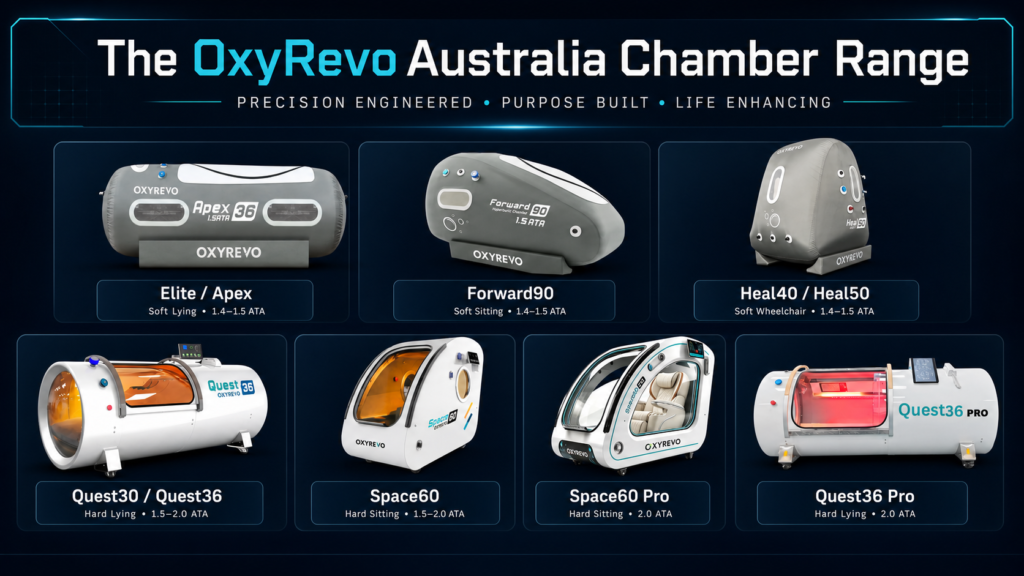
Not every chamber has the same pressure range, control mechanism, compressor, oxygen concentrator, breathing interface, cooling equipment, communication system or emergency arrangement. Use the manual and specifications supplied for the exact model and configuration being operated.
5.1 Oxygen delivery
OxyRevo product information describes concentrators capable of producing oxygen-enriched gas, commonly within a stated range of approximately 90–97% oxygen under specified conditions. This describes gas produced at the concentrator outlet. It does not necessarily describe the concentration throughout the chamber, the concentration reaching the user, the amount absorbed by the body or a clinical dose.
Output can be influenced by the concentrator model and condition, selected flow rate, altitude, ambient conditions, mask fit, tubing connections, system design and maintenance.
Oxygen-enriched gas increases the ease with which materials can ignite and burn. Never introduce unauthorised electrical equipment, ignition sources, oils, petroleum-based products or incompatible materials. Follow the model-specific prohibited-items list every time.
5.2 Pressure selection
Some OxyRevo configurations provide adjustable operating-pressure settings. Other models may be manufactured or configured for particular maximum pressures. An adjustable control never permits operation outside the chamber’s rated range.
Do not modify relief components, substitute valves, obstruct outlets, alter compressor settings, bypass a safety control or attempt to increase maximum pressure. Higher pressure is not automatically more appropriate or more effective.
5.3 Certifications and compliance documents
The OxyRevo Australia compliance register lists documents for selected systems and components, including CE-related certificates or attestations, UKCA verifications, ISO 13485 certification and materials testing. Each document must be interpreted according to its stated products, scope, standard, issuing body and validity period.
Overseas certification or testing does not by itself mean that a product is “TGA approved”, included in the Australian Register of Therapeutic Goods, authorised to treat a condition in Australia or suitable for every user.
The TGA advises that “TGA approved” and “TGA registered” must not be used to imply government endorsement. If a medical device is included in the ARTG, appropriate wording generally states that it is “included in the ARTG” and provides the relevant ARTG number.
6. Australian regulatory context
Australian regulation depends on the nature of the product, its intended purpose, how it is presented and the circumstances in which it is supplied or advertised. Describing a product as a “wellness” product does not, by itself, determine its regulatory position.
- Therapeutic goods generally need to be included in the ARTG before lawful supply or advertising unless a lawful exemption, exclusion or other pathway applies.
- Advertising must be accurate, balanced, substantiated and not misleading.
- Claims must be consistent with the product’s authorised intended purpose and regulatory status.
- Restricted and prohibited representations are subject to additional controls.
- Testimonials and social-media content may constitute advertising.
- Educational material can become advertising when it promotes the use or supply of a product.
Do not claim that mHBOT prevents, treats or cures a named disease or serious condition unless the specific product, evidence, wording and regulatory authority permit that claim. Obtain independent regulatory or legal advice where required.
7. Operational streams
Where procedures differ, this course separates instructions into two broad equipment streams.
| Equipment stream | Models generally included | Typical construction | Important note |
|---|---|---|---|
| Soft chamber stream | Elite, Apex, Forward and Heal | Flexible or inflatable chamber body | Closure, frame, pressure controls and access differ by model. |
| Hard chamber stream | Quest and Space | Rigid chamber body | Controls, doors, oxygen interfaces and maximum pressures differ by configuration. |
Confirm the complete model name, pressure rating and equipment configuration shown on the identification label and accompanying documentation.
8. How to use this course
- Complete modules in order.
- Read every safety, compliance and model-specific callout.
- Review the key terms at the end of each module.
- Consult the current manual for your exact chamber.
- Complete the knowledge checks and practical activities.
- Record questions requiring clarification.
- Mark a lesson complete only after reviewing all required material.
Selecting a completion checkbox records that you reviewed the lesson; it does not independently demonstrate practical competence. Anyone operating a chamber for another person should also complete practical orientation and supervised practice before independent operation.
| Learning element | Purpose |
|---|---|
| Core lesson | Explains required concepts and operating principles. |
| Safety callout | Identifies information that can affect user or operator safety. |
| Compliance callout | Highlights regulatory or professional boundaries. |
| Model check | Directs you to instructions for a particular configuration. |
| Key terms | Defines important technical language. |
| Knowledge check | Tests understanding and identifies areas to review. |
| Practical activity | Applies learning to a chamber, setting or role. |
9. Key terms
| Term | Definition |
|---|---|
| mHBOT | Mild hyperbaric oxygen therapy: a commonly used but non-standardised term for lower-pressure hyperbaric exposure, sometimes combined with oxygen-enriched breathing gas. State the exact pressure and oxygen-delivery method. |
| HBOT or HBO₂ | Hyperbaric oxygen treatment. In recognised clinical use, this generally involves near-100% medical-grade oxygen inside a purpose-built chamber at increased pressure. |
| ATA | Atmospheres absolute: total ambient pressure relative to a vacuum. Approximately 1.0 ATA is normal sea-level pressure. At 1.5 ATA, absolute pressure is approximately 50% higher. |
| Gauge pressure | Pressure measured above surrounding atmospheric pressure. It is not interchangeable with absolute pressure. |
| 1.5 ATA | Approximately 152 kPa absolute under standard conditions, broadly comparable to the ambient pressure at about 5 metres of seawater. Chamber exposure is not the same activity as diving. |
| Oxygen concentrator | A device that draws in ambient air and uses molecular-sieve technology to produce oxygen-enriched gas. |
| Oxygen-enriched gas | Gas containing more oxygen than normal air. Normal dry air contains approximately 20.9% oxygen. |
| AIO unit | All-in-one equipment unit. Depending on the model, it may integrate or connect pressurisation, air treatment, cooling, dehumidification and oxygen-concentration components. |
| Working pressure | The pressure at which a chamber is designed and authorised to operate. |
| Maximum working pressure | The highest authorised operating pressure for a chamber configuration. It is not a target for every session. |
| Intended purpose | The purpose for which a product is designed or represented to be used. |
| ARTG | Australian Register of Therapeutic Goods: the public register of therapeutic goods that can generally be lawfully supplied in Australia, subject to their entries and applicable exceptions. |
| Therapeutic claim | A representation that a product or service diagnoses, prevents, monitors, predicts, treats or alleviates a disease, injury, disability or physiological process. |
| Contraindication | A circumstance in which a procedure should not be used because the potential risk is unacceptable. |
| Precaution | A circumstance requiring assessment, modification, monitoring or professional advice before proceeding. |
10. Knowledge check
- Does this course provide a medical qualification?
- Why must the exact chamber model be checked?
- Does “mHBOT” have one universally accepted technical definition?
- Does concentrator output of 90–97% mean the whole chamber contains 90–97% oxygen?
- Does overseas certification automatically mean ARTG inclusion?
- Why can a therapeutic claim affect Australian regulatory obligations?
- Is the highest available pressure automatically best for every session?
Show answers
- No. It provides education and operational guidance.
- Pressure limits, controls, oxygen delivery and emergency procedures can differ.
- No. Pressure and oxygen delivery should be stated explicitly.
- No. It describes concentrator output under specified conditions.
- No. Overseas conformity documents and ARTG inclusion are different matters.
- Therapeutic representations can engage therapeutic-goods and advertising requirements.
- No. More pressure is not automatically more appropriate, safer or more effective.
Module summary
- This course provides education and operational guidance, not a medical qualification.
- All participants begin with the seven-module Foundation Layer.
- The term mHBOT is widely used but is not defined consistently.
- Mild chamber use should not automatically be equated with recognised clinical HBOT.
- OxyRevo models vary in pressure, controls, oxygen delivery and emergency procedures.
- Overseas certification is not the same as inclusion in the ARTG.
- Australian obligations depend on intended purpose, presentation, claims and supply circumstances.
- Accurate communication is essential to responsible practice.
Coming up — Module F2
What Is Hyperbaric Oxygen Therapy?
Module F2 introduces atmospheric and chamber pressure, absolute and gauge pressure, Boyle’s law, Dalton’s law, Henry’s law, oxygen partial pressure and the practical differences between mild chamber exposure and recognised clinical HBOT.
References and further reading
- Therapeutic Goods Administration — Advertising legal framework
- Therapeutic Goods Administration — General advertising requirements
- Therapeutic Goods Administration — The claim “TGA approved” must not be used
- Undersea and Hyperbaric Medical Society — Hyperbaric oxygen definition and guidance
- OxyRevo Australia — Certification and Compliance Register
- OxyRevo Australia — Model range and specifications
Complete Module F1
Before continuing, confirm that you have read the full module, reviewed the safety and compliance callouts, completed the knowledge check, identified your learning track and located the manual for your exact chamber model. Click “Mark Complete” to continue to the next module.